Class 1–12 SSC · ICSE · CBSE Competitive foundation

We don’t just finish the syllabus. We build the student.

At Veers Academy, children are taught how to study — how to read a concept once and still own it three years later. Marks follow from that. A weak core only postpones the day the questions start getting tricky.

8 years of professional teaching experience, and every student is spoken to directly.

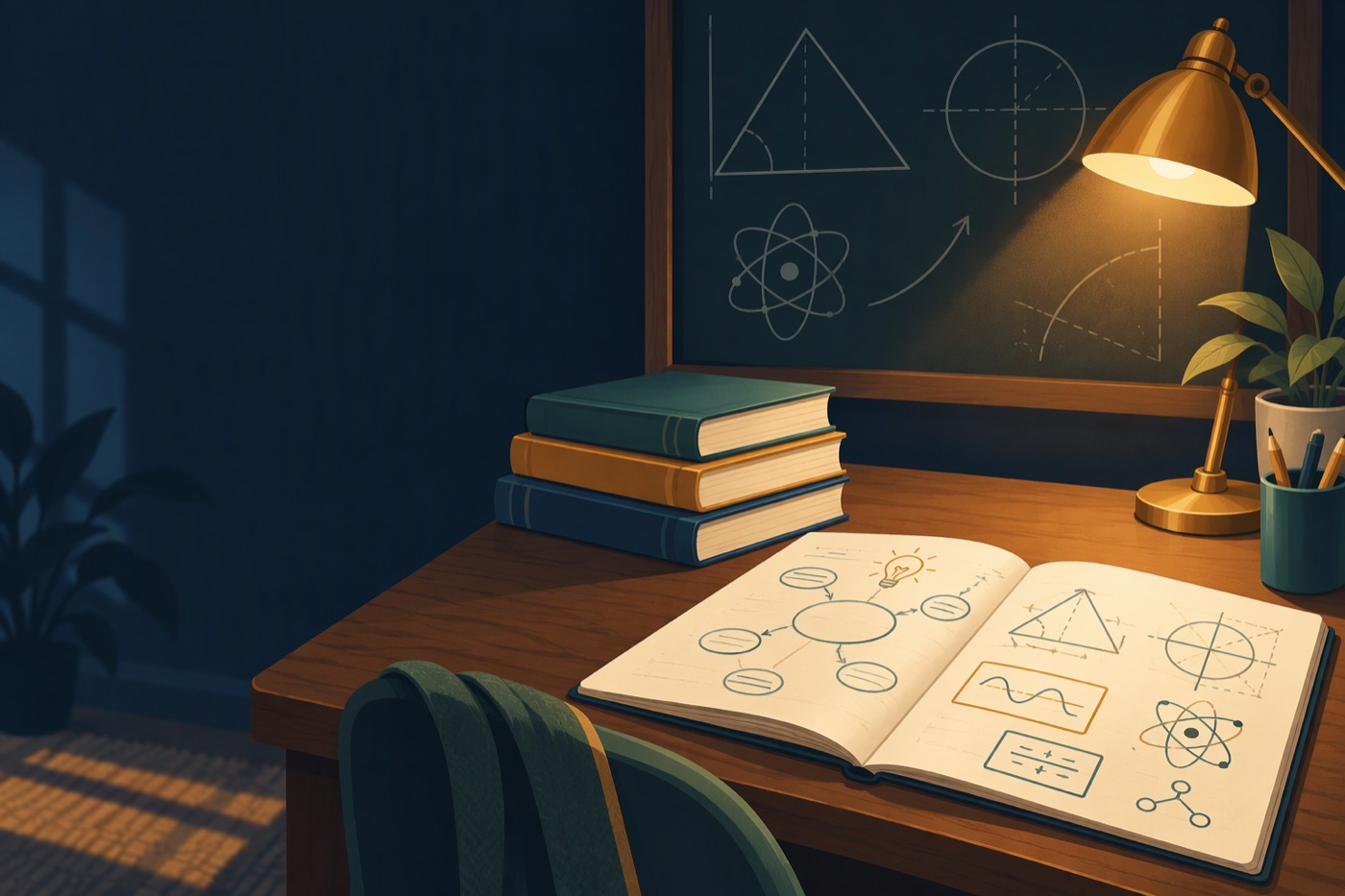
A study desk lit by a warm lamp: an open notebook with a hand-drawn concept map, a stack of textbooks, and a chalkboard of diagrams behind.

What we correct first

Long hours at the table, notes copied neatly, and still the marks don’t come. The usual reason is a hollow base — not a lack of effort.

Our method

Four things we do before we do syllabus

Anyone can cover a chapter on time. Building a student who can handle a chapter nobody has seen yet takes a different plan.

  1. Core before cramming

    Every chapter starts from the base idea it is built on. If the base is shaky, extra memorising only delays the day the question changes shape. We go backwards until something solid is found, then move forward from there.

  2. We teach how to study

    How to read a textbook properly, how to make notes you will actually reopen, how to question an answer instead of accepting it, how to revise on a schedule that beats forgetting. These skills leave our classroom with the student and keep working in every class, board and college exam that comes after us.

  3. Smart hours, not long hours

    We separate what a student can already do alone from what breaks under time and pressure, then spend the hours on the second list. Less busywork, more of the work that moves.

  4. Prepared for the competition

    Board marks are the entry ticket — a lot of students hold that ticket. The real separation is depth, speed and the confidence to sit with an unseen problem and still find a way in. That is what we train for.

Classes

Where a student joins, and where it leads

One continuous path. A Class 3 habit is what a Class 12 answer is written from.

Class 1–5

Primary — habits first

Reading carefully, writing neatly, mental maths, and the discipline of sitting still and listening. The year a child learns that thinking is more fun than copying.

  • All subjects, school syllabus
  • Reading and writing fluency
  • Confidence to speak the answer out loud

Class 6–10 · SSC / ICSE / CBSE

Secondary — the base is set here

Maths and Science are where weak bases get exposed. We teach the concept to its root, then make the student explain it back — the fastest way to know whether it landed.

  • Maths, Science, English and social subjects
  • Note-making and revision method
  • Board pattern and answer writing

Class 11–12

Higher secondary — board depth

The syllabus doubles and the margin for shaky fundamentals disappears. Sessions turn into problem-solving, with steady practice against the board paper.

  • Science and Maths streams
  • Derivations understood, not memorised
  • Full-paper practice and error review

Alongside school

Foundation for competitive exams

The part school papers don’t test: reasoning, number sense, and unusual problems that need thought rather than recall. Started early, so the real competitive years aren’t the first time a student meets hard questions.

  • Logical and analytical reasoning
  • Concepts pushed past the board level
  • Speed and accuracy under time

A week here

What actually happens

  1. Concept class

    The chapter is built from its base idea. Questions are expected — a student who stops asking is the signal that something is unclear.

  2. Method drill

    Students make their own summary of the day. We correct how they studied, not only what they wrote down.

  3. Doubt clinic

    Questions left over from school, homework and tests. No question is treated as a silly one; that is how doubt gets hidden instead of solved.

  4. Weekly review

    What is solid, what is still soft, and exactly what to practise at home. Parents are kept in the same loop as the student.

Check batch fit

Tell us the class and the goal. We’ll reply on WhatsApp.

Fill these four choices and the message writes itself — timings, fees and the batch strength are confirmed on the call.

  • Talk directly to the teacher, not an office
  • A short discussion about the student before joining
  • SSC, ICSE and CBSE are handled separately
Main goal

Message preview

Send on WhatsApp

About

Eight years of teaching, still measured by what the student can do alone

Snehal Desai has 8 years of professional experience in teaching. Veers Academy was built on a plain observation: students who work hard and still stall are almost never lazy — they were never shown how to study.

So the teaching starts from the base. Concepts are taken to their root, notes are made by the student’s own hand, and revision is planned instead of left for the night before the exam. The syllabus does get finished; it just isn’t the only thing being produced.

A syllabus is finished by everyone. A student who knows how to study is the one who stops needing me — and that is the actual goal.

Snehal Desai, Veers Academy
Call Snehal Desai 9226519921

Questions parents ask

Before you call

Is this only syllabus completion for the exam?

No, and that is the main difference. The exam is a consequence of a strong base, not the plan itself. Preparing only for the current paper produces a student who is lost one class later; we build the core so the next class gets easier instead of harder.

My child studies for hours but the marks don’t show. Why?

Usually two reasons: the base under the chapter has gaps, so the new material has nothing to attach to; or the study method is copying rather than recalling. Both are fixable, and the first step is finding which one it is. That is what the discussion before joining a batch is for.

Which boards and classes are covered?

Class 1 to 12, for SSC, ICSE and CBSE, each handled according to its own pattern. Alongside school work, foundation for competitive exams is taught — reasoning, number sense, and problems that need thinking instead of memory.

What are the fees, timings and batch size?

These depend on the class, the board and the batch running at the time, so they are confirmed on a call with Snehal Desai on 9226519921 — or use the WhatsApp message from the form above.

How does a student join?

Call or send the enquiry. There is a short conversation about the student’s class, board and current level, then a meeting to see the batch and decide together whether it fits.
Contact

One number. The teacher answers.

Call 9226519921 WhatsApp